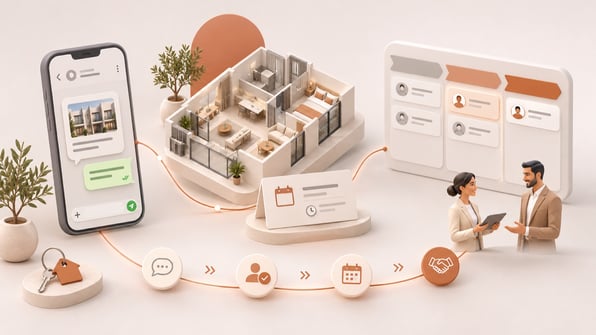

Healthcare and wellness businesses do not grow simply by generating more enquiries. People need to find the right service, understand what happens next, book with confidence, arrive prepared and receive a thoughtful follow-up. When those steps live across disconnected forms, inboxes, booking tools and spreadsheets, the experience can feel fragmented even when the care itself is excellent. In this guide, I look at where HubSpot for healthcare and wellness businesses can help in the UAE and GCC—and where a specialist clinical system must remain in control.
Short answer: HubSpot can be a strong marketing, sales and service CRM for healthcare providers and wellness businesses that need to manage enquiries, consent-aware communications, bookings and relationships across teams. I would use it as the engagement and growth layer around an electronic health record (EHR), electronic medical record (EMR), practice-management or booking platform. It should not be treated as a clinical record, diagnostic tool or automatically compliant store for UAE health data. Confirm data residency, processing, integrations and regulatory fit with your privacy, IT and legal teams before transferring any patient or health information.
I am writing for clinic owners, healthcare operators, marketing leaders and wellness founders evaluating a CRM—not offering clinical, legal or regulatory advice. I use “patient” where the service is clinical and “client” or “member” for non-clinical wellness services; the right terminology and data rules depend on the actual service.
- HubSpot is best considered for enquiry management, marketing, sales, service and relationship workflows.
- Keep clinical documentation, prescriptions, diagnostics and care decisions in approved clinical systems.
- Use minimal, non-clinical CRM data by default; route appointment and treatment records through a verified system.
- For UAE healthcare data, check the relevant federal and emirate rules, storage locations, cross-border access and vendor terms before connecting systems.
- Use fixed workflows for predictable reminders and consider bounded AI agents for approved non-clinical replies and follow-up with tested human hand-offs.
- Start with one patient or client journey, define ownership and measures, then expand after a privacy and integration review.
1. Healthcare and wellness in the UAE and GCC: a growing, diverse market
The UAE healthcare market combines public and private providers, employer-sponsored insurance, a highly international resident population, specialist clinics and a growing visitor economy. The wider wellness market is broader still: preventive health, fitness, nutrition, mental wellbeing, beauty, spa services, workplace wellness, recovery and wellness tourism all have different customer journeys and operating requirements. I would not treat “healthcare and wellness” as one buyer segment or assume a CRM design for a hospital will fit a boutique studio.
Recent official and sector data give useful context. Dubai Health Authority’s 2024 statistical yearbook reports 5,372 licensed healthcare facilities and 66,070 licensed healthcare workers in the emirate. It also records about 13.18 million outpatient visits in 2024. Separately, DHA’s Health Accounts System of Dubai 2024 release, published in January 2026, puts total Dubai healthcare expenditure at approximately AED 24.55 billion, up 10% year on year. These figures describe Dubai’s healthcare activity and financing; they are not a measure of CRM adoption or a GCC-wide total.
Wellness has its own scale. The Global Wellness Institute’s November 2025 UAE wellness-economy report estimates the UAE wellness economy at US$40.8 billion and says it grew at an average annual rate of 14.3% between 2019 and 2024. The report estimates wellness tourism at US$11.3 billion. Its wellness-economy definition spans multiple sectors, so this is not the addressable market for a particular clinic, gym or CRM vendor. It does, however, underline the variety of businesses competing to attract, serve and retain clients.
For a more current regional lens, the Global Wellness Institute’s 2026 Global Wellness Economy Monitor summary reports that the Middle East–North Africa wellness economy grew by an average 9.7% annually from 2019 to 2025—the fastest regional growth rate in its comparison. This is a MENA estimate, not a UAE-only forecast, and it does not mean every wellness operator will grow at that pace.
For a UAE operator, that variety creates a practical challenge: one person may discover a service online, ask questions in English or Arabic, verify insurance or package details, book around work or travel, and expect a responsive follow-up. GCC expansion adds market-by-market differences in licensing, payer arrangements, language, consent, data handling and service availability. A regional CRM should make those differences visible instead of hiding them behind one generic “lead” status.
2. Healthcare marketing, sales and CRM pain points
When I review a patient or wellness-client journey, I look for the hand-offs. Problems often occur between discovery and the first appointment, or between a completed visit and an appropriate next step. The following are common operating patterns to investigate—not claims that every UAE provider has the same problem.
- Enquiries are scattered. Website forms, phone calls, WhatsApp, social messages and referral emails may be handled by different people. No one can reliably see whether a question received a useful response.
- Marketing measures activity rather than attended care. Teams report clicks, calls or form submissions without connecting them to booked, attended or repeat appointments. The data may be split between the CRM, booking system and clinic software.
- Appointment availability is hard to explain. A campaign promotes a service or location, but reception cannot quickly see the relevant appointment type, clinician availability, insurance constraints or next step.
- Follow-up is inconsistent. A person who asks for information may receive no response, too many reminders, or a message that arrives after they have already booked elsewhere.
- Ownership changes mid-journey. Marketing, a call centre, reception, a clinician, billing and customer service may each hold part of the relationship, with no agreed hand-off standard.
- Language and location are treated as afterthoughts. A contact’s preferred language, requested branch, market or time zone may be missing, inferred incorrectly or kept in free text.
- Privacy risk grows with convenience. Staff may paste symptoms, test information or treatment details into notes, email or chat because it feels faster than using the clinical system.
- Retention is generic. A wellness membership, annual screening reminder, post-procedure check-in and chronic-care recall are different journeys. A single bulk campaign is unlikely to serve them all appropriately.
A CRM can make the commercial journey more visible, but it cannot fix unclear service capacity, incomplete clinical hand-offs or a poorly defined consent process by itself. I start with the journey and responsibilities, then select the system that should own each piece of information.
3. What healthcare and wellness businesses are missing
The missing piece is often not another campaign or another dashboard. It is a dependable operating model that connects demand to capacity and follow-up while keeping clinical information under appropriate control. I would expect a mature design to include:
- A shared service catalogue: consistent service names, locations, audience, eligibility notes, booking path and responsible team across pages and staff.
- Clear enquiry ownership: a named team or person, response expectation, after-hours handling and an escalation route for unanswered requests.
- Journey definitions: separate pathways for new enquiries, existing patients, wellness members, referrals, corporate accounts, insurance queries and general service feedback.
- Consent and preference records: a clear purpose, channel preference, language, opt-out handling and evidence of how the permission was collected. Marketing consent is not the same as clinical consent.
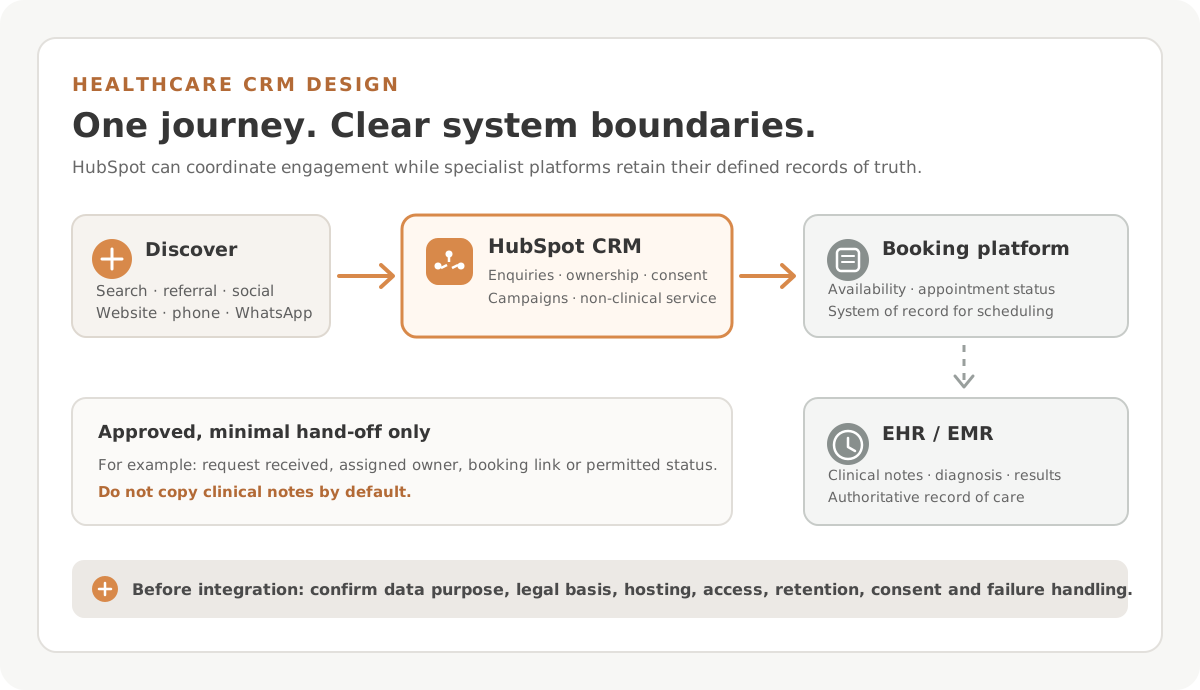
- A safe data boundary: a written rule for which system may hold identity, service interest, appointment status, clinical notes, health history, insurance documents and payment details.
- Cross-system measurement: agreed definitions for enquiry, booking, attendance, cancellation and repeat visit, with a named source of truth for each.
- Practical governance: role-based access, retention rules, auditability, vendor review, integration monitoring and a process to correct or delete data where required.
That foundation helps a provider ask a better question than “Which CRM has the most features?” The better question is: “Which system should own each step, and can our team operate that design safely every day?”
4. Is HubSpot a good CRM for healthcare and wellness businesses?
Yes, for the right job. HubSpot can help healthcare and wellness teams organise enquiries, coordinate marketing and sales activity, manage service conversations and report on non-clinical customer journeys. HubSpot’s pages on Marketing Hub for healthcare and HubSpot for Healthcare describe use cases around marketing, forms, landing pages, coordinated campaigns and CRM-based lead management. I see the strongest fit when an organisation wants a shared engagement layer across teams and its existing clinical or booking platforms remain the trusted systems for care delivery.
Examples of appropriate CRM-side records may include a person’s contact details, preferred branch, broad service interest, enquiry source, communication permissions, assigned relationship owner, appointment-request status or corporate-account relationship—subject to a documented legal and privacy review. Keep diagnoses, symptoms, consultation notes, prescriptions, lab results, insurance documents and other sensitive clinical details in the approved clinical system unless your compliance team has explicitly approved a specific HubSpot data design and feature configuration.
HubSpot is less likely to be the right core platform if your primary need is an EHR/EMR, clinical documentation, medication management, diagnostic workflow, claims processing, clinical scheduling, patient portal or regulated care-record retention. Those needs should be assessed against specialist healthcare systems. HubSpot may still connect to parts of that stack, but an integration does not make the CRM the clinical source of truth.
| Business need | Potential HubSpot role | System boundary to confirm |
|---|---|---|
| Website enquiries and service information | Forms, CRM ownership, source tracking, approved follow-up | Collect only necessary information; avoid symptom or diagnosis fields |
| Appointment requests | Capture request and route it to the booking owner | Availability, confirmation and clinical scheduling belong to the approved booking system |
| Marketing and wellness programmes | Permission-based audience segmentation and campaign reporting | Confirm purpose, consent, retention, sensitive-data use and subscription eligibility |
| Clinical care and records | Usually not the primary record system | EHR/EMR or licensed care platform remains authoritative |
| Service recovery and non-clinical questions | Route and track communication with the right service team | Escalate clinical advice, urgent symptoms and complaints through approved protocols |
If you are still comparing CRM options, I would use the same operating model and three-year cost assumptions in our HubSpot vs Zoho vs Odoo CRM comparison. For process readiness, see the HubSpot implementation readiness checklist for UAE businesses. For a wider view of HubSpot’s marketing, sales, service and data tools in the region, see our HubSpot services in Dubai.
5. HubSpot features, workflows and AI agents to plan
The platform should be configured around the patient or client journey, not around a wish list of every feature. I would map each requirement to an owner, an approved data source, a measurable outcome and the HubSpot subscription that actually includes it. HubSpot features, limits and sensitive-data availability can change; confirm current product documentation and your portal entitlements before committing. If you need a broader engagement plan across content, marketing and CRM operations, review our HubSpot Marketing Hub services for UAE businesses.
A. CRM records and segmentation
- Define contact types or lifecycle stages that distinguish prospects, existing patients/clients, members, referring professionals and corporate accounts.
- Use controlled properties for country, preferred language, requested location, service line, enquiry type and communication preference.
- Keep the property set lean. A custom field should have a clear user, purpose, source, access rule and retention rationale.
- Use company records for insurers, employers, referral partners or multi-site accounts where relevant. Keep marketing relationships separate from clinical affiliations.
B. Forms, landing pages and channel consent
- Create service-specific enquiry forms that request only what staff need to respond. A “request a call” form usually does not need medical history.
- Make privacy notices and marketing preferences clear. A person requesting an appointment is not automatically consenting to unrelated promotions.
- Offer practical language and location choices rather than guessing from IP address or a phone number.
- Test how records are created, updated, deduplicated and routed when a returning patient uses a different email or phone number.
C. Pipelines and hand-offs
A pipeline can represent a commercial or service process—for example corporate wellness sales, a new clinic enquiry, a membership consultation or an unresolved non-clinical request. Use explicit stages such as “enquiry received”, “contact attempted”, “booking requested”, “booking confirmed” and “closed/no response” only when HubSpot is the agreed owner for those status updates. Do not mirror a clinical workflow merely to make the CRM dashboard look complete.
For UAE and GCC teams, decide which market owns the relationship, how local business hours work, when Arabic-speaking support is needed and where an unanswered enquiry goes. Our HubSpot lead-routing guide for UAE and GCC teams outlines a practical framework for ownership, exceptions and testing.
D. Workflows and communications
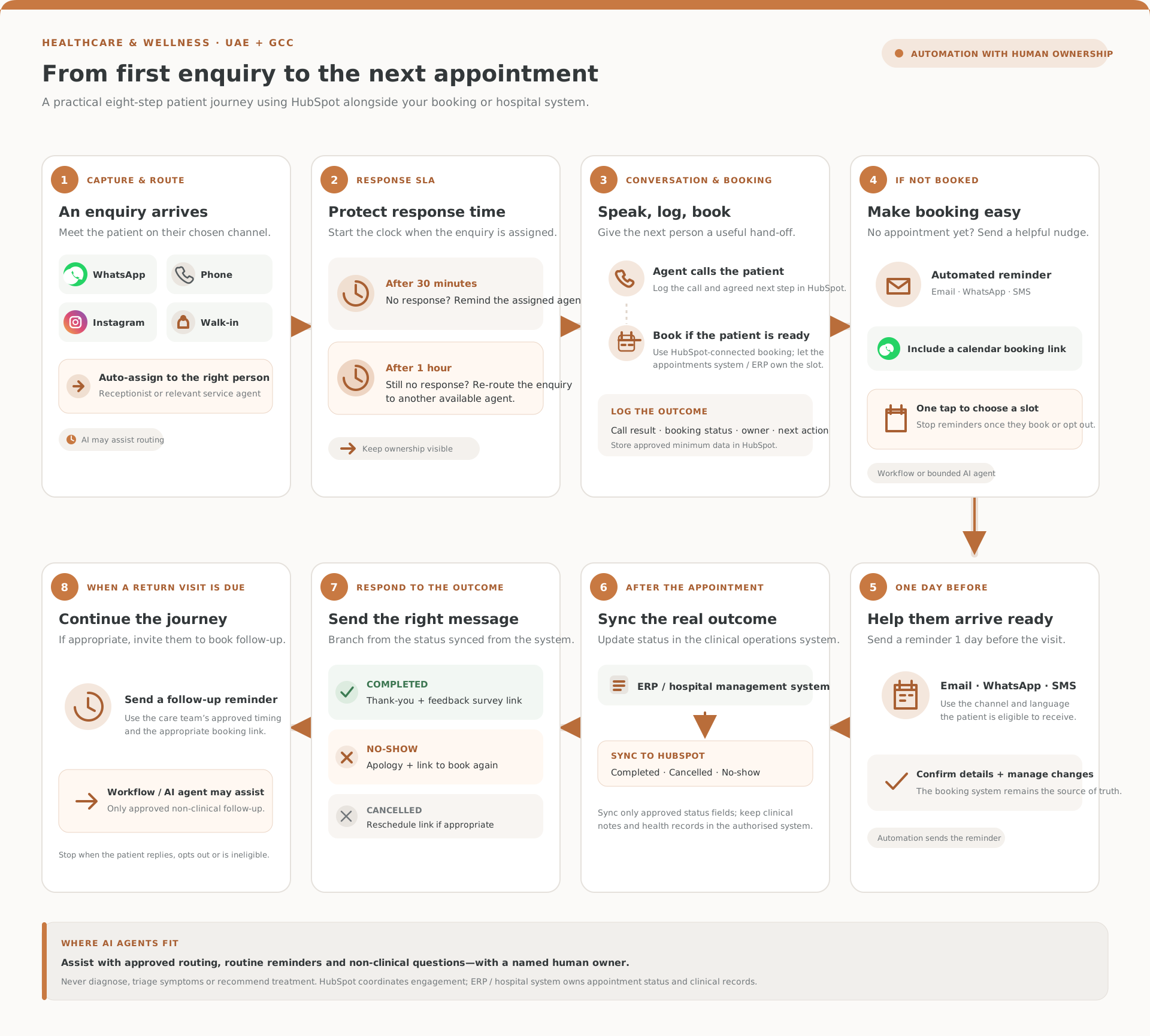
- Notify the right team when a high-intent enquiry arrives and define a backup owner for after-hours or leave coverage.
- Send an appropriate acknowledgement after a request, then stop promotional follow-up when the person opts out, replies, books or reaches a defined boundary.
- Separate operational messages (such as a booking confirmation) from marketing messages and configure them using the right system and legal basis.
- Use automation to coordinate work, not to make clinical decisions, triage symptoms or recommend treatment.
- Confirm current plan and seat requirements for workflows, marketing automation, service features, custom objects and sensitive data before designing around them.
E. AI agents for automated, bounded follow-up
AI agents can support timely follow-up when the job is clearly bounded and a person remains accountable. I separate predictable tasks from judgment-based ones: use a conventional workflow for a fixed reminder after a confirmed booking, and consider an AI agent when a reply needs to be interpreted, summarised, answered from approved non-clinical information or routed to the right team. For example, an agent might help answer a question about opening hours or the booking process, prompt a staff member about an unanswered enquiry, or summarise a service-feedback response for review. It should not infer consent from silence; marketing follow-up still needs the right permission and channel rules.
HubSpot’s guidance, updated 26 October 2026, distinguishes fixed-rule workflows from AI agents that interpret less structured requests. Its Customer Agent can answer support questions from selected content and, depending on confidence, respond with a source, ask a clarifying question or reassign the conversation to a person. HubSpot also supports configuring immediate or later human hand-off. The relevant subscription, channel, permissions and credit requirements depend on the account, so verify these before designing around the feature: HubSpot’s guide to choosing AI agents or workflows and its Customer Agent hand-off guidance.
- Limit the agent’s knowledge to approved service information such as locations, hours and booking steps; review answers before deployment.
- Route symptoms, urgent concerns, adverse events, requests for medical advice, uncertainty or an explicit request for a person to trained staff through a tested hand-off.
- Do not use an agent to diagnose, triage symptoms, recommend treatment, interpret test results or collect sensitive health details in the marketing CRM.
- Stop or suppress messages when the person replies, books, opts out, is ineligible, or a system sync fails. Monitor hand-offs and failed automations.
F. Service and feedback management
A service inbox or ticket process may help teams manage non-clinical enquiries, billing questions, membership changes, directions, accessibility requests or feedback. It should have clear categories, response expectations, ownership and escalation routes. Clinical complaints, adverse events, urgent symptoms and requests for medical advice need a clinically approved process; a CRM ticket should not become an informal substitute.
6. Integrations with essential healthcare and wellness tools
Integration work is where CRM projects either become useful or create a new data risk. I would first list the systems the business already relies on, decide which application owns each field, and define the minimum data that needs to cross each boundary. A connector appearing in a marketplace does not automatically make its data flow suitable for clinical information or local regulatory requirements.
| System category | Useful hand-off to evaluate | Questions before connecting |
|---|---|---|
| EHR/EMR or hospital information system | Approved identity match or limited non-clinical status where permitted | Which system is the source of truth? Is health data allowed to leave it? Where is it processed and stored? |
| Practice management and appointment booking | Request received, appointment status or a secure booking link | Can it prevent duplicate bookings? Are confirmations and changes synchronised reliably? |
| Telehealth and patient portal | A link or approved lifecycle status—not consultation content by default | Is identity verification, recording, consent and access controlled in the specialist platform? |
| Billing, insurance and payment | A permitted payment or account status for service operations | Are card, claim and policy documents kept out of general CRM fields and attachments? |
| Call centre, telephony, WhatsApp or messaging | Channel source, owner and conversation follow-up where consent and policy allow | What content is retained, who can see it, how are opt-outs and clinical escalations handled? |
| Analytics, finance and identity tools | Aggregated campaign and operational reporting where lawful | Can reporting be de-identified or aggregated? Are access and retention rules aligned? |
The Abu Dhabi Department of Health publishes 2026 Health Information Exchange standards for healthcare providers participating in Malaffi. This is a reminder that clinical interoperability follows healthcare-specific standards and governance. A CRM integration should be designed with the provider’s digital-health and data-governance teams; it should not bypass the approved exchange or EMR architecture.
HubSpot offers a broad App Marketplace and developer APIs. For a healthcare connector, verify the vendor’s current product, data fields, hosting, subprocessors, access model, failure handling, support obligations and contractual terms. If no suitable native connector exists, assess middleware or a custom integration only after clinical IT and privacy approval. If you are migrating from another CRM, use our HubSpot CRM migration and field-mapping checklist to plan test records and acceptance checks.
7. Health-data privacy, hosting and HubSpot limitations
This section matters more than any feature comparison. The UAE’s official government portal explains that Federal Law No. 2 of 2019 on ICT in health fields regulates health-sector ICT and requires health data to be kept confidential and protected. Applicability, implementing rules, exceptions and regulator requirements can depend on the emirate, type of provider and service. Providers in Abu Dhabi should also review current DoH policies on data governance, sovereignty and the Malaffi exchange; Dubai facilities should confirm current DHA rules. GCC markets each have their own legal regime.
HubSpot’s own data-hosting FAQ, updated July 24, 2026, lists data-centre regions in the United States, Canada, Australia and the European Union (Germany)—not the UAE. It also notes that users accessing accounts from other regions and certain processing by affiliates or subprocessors can involve transfers beyond the account’s primary hosting location. An EU or US hosting option is not the same thing as UAE-local hosting.
HubSpot documents Sensitive Data and HIPAA-related configuration for eligible accounts. Its September 2026 documentation says Sensitive Data properties are available only in certain products and plans; some tools, including chatbots, personalization tokens and playbooks, do not support those properties, while Highly Sensitive Data has additional restrictions. This feature and a HIPAA Business Associate Agreement address a specific US regulatory context. They do not establish that a HubSpot account meets UAE health-data residency or all local healthcare requirements.
- Classify every field and integration payload: contact data, service interest, appointment metadata, health data, payment data and clinical records.
- Ask your privacy officer, health-information lead, IT/security team and local counsel which laws and regulator standards apply to each data flow.
- Check HubSpot’s current hosting region, support access, subprocessors, contract terms, retention, deletion and cross-border access. Save the evidence.
- Design the integration to minimise data. Prefer a secure booking link or a simple permitted status over syncing clinical detail.
- Test role permissions, audit trails, consent, data correction, deletion, connector failure and incident response before any live launch.
- Keep a written decision that identifies the approved purpose, system of record, accountable owner and prohibited data fields.
Do not assume a CRM is suitable for patient health records merely because it offers access controls or encryption. Also do not assume that putting a sensitive value in a protected property makes every connected workflow, form, chatbot, report, email or integration safe for that value. Review the current HubSpot Sensitive Data setup requirements and its tool-by-tool Sensitive Data limitations with your administrator and compliance team.
8. A practical HubSpot implementation roadmap for a healthcare or wellness business
I would phase a project so the organisation can test its service design and privacy boundaries before expanding automation.
- Choose one journey. Start with a specific non-clinical pathway, such as a new wellness membership enquiry, a corporate health-programme request or a general clinic appointment enquiry.
- Map people, channels and systems. Draw the steps from first discovery through response, booking, attendance and follow-up. Mark every hand-off and the application that owns the status.
- Agree the data boundary. List the fields HubSpot may store and the fields it must never receive. Get privacy, clinical IT and security review before adding health information.
- Define the CRM model. Create only the properties, lifecycle stages, pipelines, teams and permissions required for this journey. Use controlled values for market, language, location, service category and enquiry status.
- Build the minimum workflow. Assign an owner, create a task or alert, send a suitable acknowledgement where permitted, and provide a visible fallback for missing or conflicting data.
- Connect one system at a time. Begin with a booking URL or a low-risk status field if appropriate. Verify identity matching, field ownership, data minimisation, retry behaviour, logs and error notifications.
- Test real exceptions. Include existing contacts, duplicates, after-hours enquiries, language mismatches, opt-outs, cancelled appointments, inactive owners and failed integrations. Use synthetic test data, not live clinical records.
- Train each role and document governance. Explain what users should enter, where clinical notes belong, how to handle a privacy request, who approves campaigns and how incidents are escalated.
- Review before scaling. Compare response and booking measures with a baseline. Fix unclear ownership and integration errors before adding more locations, services or automated messages.
This resembles our broader HubSpot implementation readiness process: clarify the business process, data, ownership and integration requirements before configuration. For a wellness brand managing several channels, a connected HubSpot and WhatsApp workflow may also be relevant, subject to consent, privacy and clinical escalation rules.
9. Healthcare and wellness CRM metrics to track in HubSpot
A CRM should help a provider understand whether communication and service operations are working—not become a source of unverified clinical outcome claims. I would agree metric definitions with the booking and clinical-system owners, then attribute only what the available data supports.
| Question | Possible measure | Source and caution |
|---|---|---|
| Are enquiries being handled? | Enquiry volume, owner coverage, time to first meaningful response | HubSpot activity data; define business-hours rules and response event |
| Which channels contribute to requests? | Enquiries or qualified booking requests by source, campaign and service | HubSpot plus consistent UTM/source conventions; do not confuse attribution with causation |
| Are requests converting into appointments? | Request-to-booking and booking-to-attendance rate | Needs a reliable booking-system hand-off; HubSpot alone may not know attendance |
| Are clients returning? | Repeat visit or membership renewal rate by cohort | Use approved, minimised status data; avoid inferring care outcomes from purchase behaviour |
| Are service teams responding? | Open requests, age, response and resolution time, escalation count | Use a defined ticket process; do not mix clinical severity with a general service priority |
| Are communications appropriate? | Consent coverage, opt-out rate, bounce rate and complaint rate | Check channel rules and audience eligibility; an open is not proof of reading or health impact |
A carefully designed report should show the time period, source system, denominator, exclusions and any missing integration data. If booking attendance is not synchronised, report “booking requests” rather than “appointments attended”. If a campaign and a visit are correlated, do not state the campaign caused a clinical outcome. HubSpot’s current process-automation guide also notes that available tools depend on the products and subscriptions in the account.
10. Frequently asked questions about HubSpot for healthcare and wellness
Is HubSpot a good CRM for healthcare businesses?
Yes, for marketing, enquiry management, sales and non-clinical service workflows when the data design is approved. It should complement an EHR/EMR or practice-management platform rather than replace clinical records, scheduling or care systems.
Can a clinic use HubSpot to store patient medical records?
No, not by default. A provider should keep clinical notes, diagnoses, prescriptions, results and other regulated health records in its approved clinical system. Any proposed exception needs a documented legal, security, hosting and product-feature review.
Does HubSpot comply with UAE healthcare data rules?
Do not assume so. HubSpot provides security and sensitive-data controls, but its published hosting regions do not include the UAE. Your organisation must assess applicable UAE and emirate requirements, data location, cross-border processing, vendor terms and actual data flows with qualified advisors.
Can HubSpot integrate with an EHR or clinic booking system?
Yes, if an appropriate integration exists or is built and approved. Confirm the connector’s supported records and fields, system of record, identity matching, data location, security, failure alerts and support. A technical connection alone does not establish regulatory suitability.
Can HubSpot automate appointment reminders?
Yes, in some designs, but the booking platform is often the better source for operational reminders. Confirm the current subscription, messaging channel, consent and integration behaviour. Prevent duplicate or outdated reminders when an appointment changes.
Can a wellness business use HubSpot without clinical features?
Yes. A fitness studio, spa, nutrition brand or wellness membership provider may use HubSpot for enquiries, corporate sales, membership interest and permission-based communications. It should still classify the personal data it collects and avoid unnecessary health details.
Can HubSpot show which marketing campaign led to patient revenue?
Sometimes, if booking and revenue data can be lawfully and reliably connected. Attribution is affected by tracking gaps, consent, offline activity and repeat journeys. Report the method and limitations; do not present an attribution model as proof that marketing caused a care outcome.
What should a UAE clinic do before implementing HubSpot?
Start by mapping the journey and classifying each data field. Confirm the applicable regulator rules, hosting and cross-border data flows, choose the clinical system of record, define consent and access, then test one low-risk workflow with synthetic data before launch.
11. Source notes
I have linked the underlying government datasets, regulator guidance and HubSpot product documentation next to the claims they support so readers can check the original context. Statistics use each publisher’s own definitions; the Dubai figures are not GCC totals. I reviewed the linked material on 12 November 2026. This is a marketing and implementation perspective, not medical, legal or regulatory advice.
HubSpot features, hosting, plan eligibility and legal obligations can change. Confirm current details with the relevant authority, provider and vendor before implementation.
Author: Asif Ahmed is the Founder & CEO of Arcs & Curves and a HubSpot Consultant.
Talk to Arcs & Curves