.webp?width=145&height=145&name=Hubspot%20Platinum%20(1).webp)


A website design brief should explain who the website serves, what visitors need to do, which pages and functions are required, who supplies the content, and how the finished work will be accepted. For a UAE business, it should also address language requirements, regional audiences, enquiry routing and the people responsible for approvals. Give each agency the same brief so you can compare proposals on a common basis.
“We need a modern website” is a reasonable starting point for a conversation. It is not enough information to price a project reliably. One proposal might include copywriting, Arabic layouts and CRM integration. Another might assume your team provides everything except the design and build. The totals can look comparable while the deliverables are very different.
Use the ten decisions below to prepare a useful brief before requesting website design quotes in Dubai or elsewhere in the UAE. You do not need to solve every technical question yourself. Identify what is known, what needs discovery and who can make each decision.
What should a website design brief contain?
Include these ten areas:
- Business objectives and measures of success.
- Priority audiences and their main tasks.
- Page types, content inventory and language scope.
- Content production and approval responsibilities.
- Required functions and system connections.
- Search visibility and existing URL requirements.
- Accessibility and performance expectations.
- Measurement and enquiry handling.
- Budget, timing and project approvals.
- Ownership, training and support after launch.
The most useful brief makes assumptions visible. If Arabic content is a possible second phase, say so. If management has not agreed on the CRM, list that as an open dependency. An agency can then price a defined discovery stage or an option instead of hiding uncertainty inside a fixed quote.
1. Choose the business outcome before the visual direction
Start with the work the website must do for the business. A service company might need better qualified enquiries. A distributor might need buyers to find the correct product information. A professional firm might need procurement teams to verify its capabilities before a meeting.
For the first release, record:
- Primary outcome: the change that would make the project worthwhile.
- Current position: the evidence you have today, or a clear measurement gap.
- Visitor action: the next step a relevant prospect should take.
- Review owner: the person who will assess progress after launch.
For example, a hypothetical engineering supplier might prioritise complete project enquiries over general contact submissions. Its brief could request fields for project type, location and required service, with a clear internal routing rule. This is an illustrative requirement, not a claimed client result.
Avoid inventing a conversion target when nobody has checked the baseline. Ask for measurement to be established first, then agree on targets using actual traffic and enquiry quality.
2. Describe your audiences through their tasks
“Businesses in the UAE” is too broad to guide the navigation or content. Identify the people most likely to use the site and what they need before contacting you.
For each priority audience, answer:
- What problem brought them here?
- Which service or product information do they need?
- What evidence would help them trust the business?
- What question could stop them from taking the next step?
A procurement manager may need specifications and certifications. A founder may need a clear explanation of scope and next steps. Give the agency these differences so it can propose a structure around buying needs rather than your internal departments alone.
3. Define page types, languages and content volume
A page count is useful, but it does not describe the full scope. Ten service pages that share one layout differ from ten pages with different interactive features. Ask proposals to distinguish reusable templates, individual pages and content records such as products or articles.
Include an initial inventory:
- Core pages: home, about, contact and relevant service pages.
- Repeatable content: case studies, team profiles, products or resources.
- Special journeys: booking, quotation, checkout or gated downloads.
- Existing content to keep, rewrite, merge or retire.
Decide whether English, Arabic or other languages are required at launch. Arabic scope should address translation ownership, right-to-left layouts, navigation, forms and review by a competent language reviewer. Do not assume that adding a language selector includes these tasks.
4. Assign content and brand responsibilities
Content can become a project dependency when its ownership is unclear. Specify who writes service explanations, obtains approved client quotes, supplies photographs and signs off factual claims. Identify missing brand assets before the design stage starts.
Ask the proposal to separate:
- Content strategy and page outlines.
- Copywriting, editing and translation.
- Photography, illustration and licensed assets.
- Content entry, formatting and migration.
- Internal review and approval rounds.
Share visual references with a reason: perhaps you like the navigation clarity or the way a page explains a complex service. A list of attractive websites without that explanation can send the design team in several directions. For the wider delivery process, see our approach to website design.
5. Explain functions as complete journeys
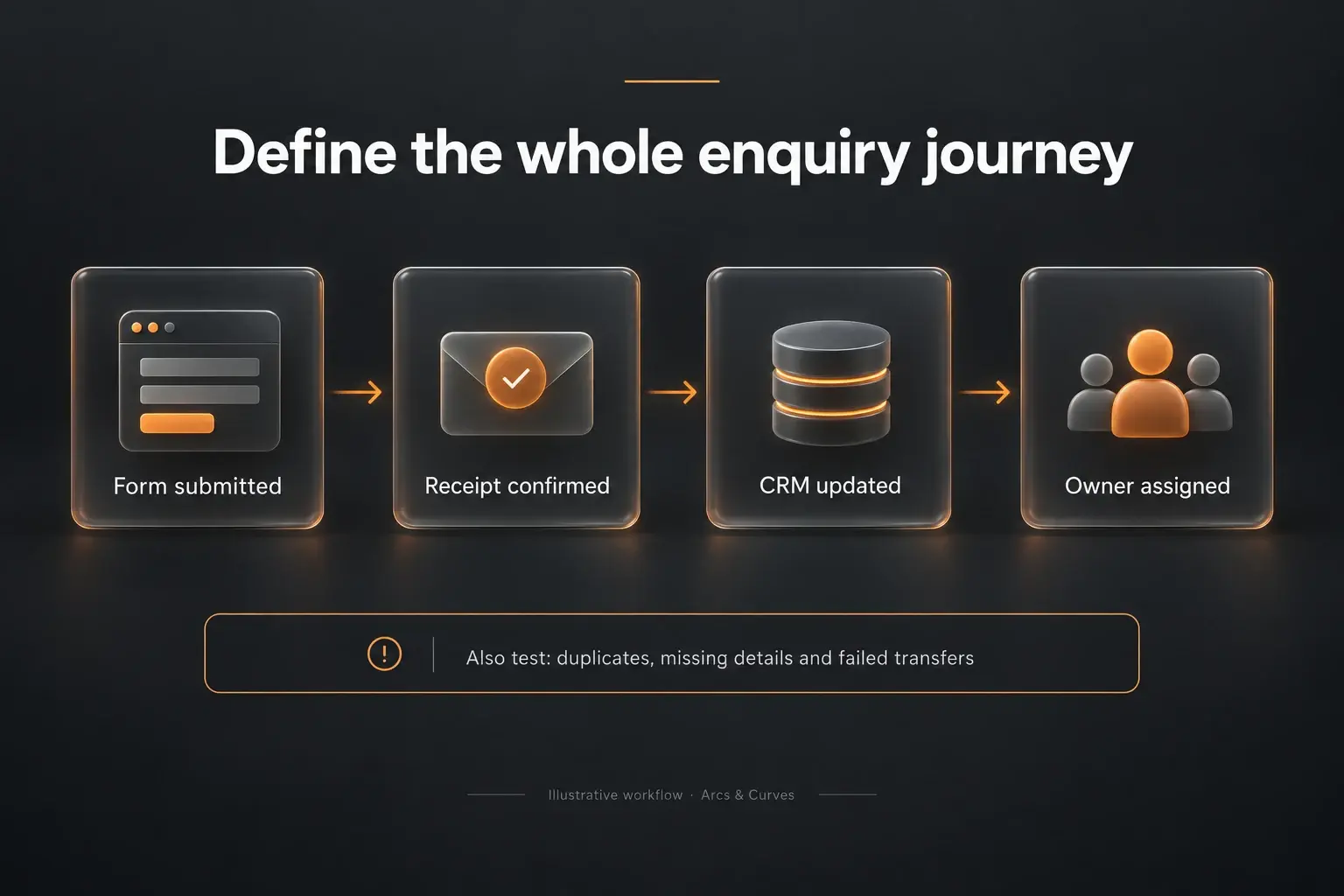
“CRM integration” can mean anything from sending a notification email to creating and routing structured records. Describe the expected journey and ask the agency to validate the connection before committing to delivery.
For an enquiry form, your brief could specify:
- A visitor selects a service and submits their details.
- The website confirms receipt clearly.
- The agreed information reaches the CRM.
- A rule assigns the enquiry to the responsible team.
- The team can identify a failed submission or transfer.
Record the systems involved, the fields required, access dependencies and any recurring connector costs. Include exceptions such as duplicate contacts or a missing territory. If HubSpot is part of the project, our implementation readiness checklist helps you prepare the process and data decisions behind the connection.
6. Put SEO and AI search requirements into the scope
For a redesign, ask for an inventory of existing URLs and an agreed plan for content that moves or disappears. Define responsibility for redirects, page titles, descriptions, crawlability and launch checks. An attractive new site can still create avoidable search problems if these tasks have no owner.
For content, request clear service explanations, descriptive headings, useful internal links and evidence behind business claims. Keep important answers available as text, even when a diagram or video supports them.
Google's guidance for AI search features says established SEO practices remain relevant and that no additional technical requirements are needed for inclusion in AI Overviews or AI Mode. Ask agencies to explain their deliverables rather than promise guaranteed AI citations. This Google guidance does not establish how every other AI service selects its answers.
7. Make accessibility and performance testable
“Fast and accessible” needs a test plan. Agree which page types, devices and journeys will be checked, what tools will be used and how issues will be resolved. Include keyboard navigation, visible focus, labelled forms and readable text in the discussion.
The 2026 WebAIM Million study found automatically detectable WCAG failures on 95.9% of the one million home pages tested in February 2026. This is a broad sample of popular websites, not a UAE business benchmark. Automated checks also cannot detect every accessibility issue. The useful implication for a brief is to budget for evaluation rather than assume accessibility comes with a modern template.
W3C recommends involving users with disabilities early and throughout web projects. Ask how user feedback and standards-based checks will fit the scope, including any specialist review your project needs.
For performance, Google's Core Web Vitals guidance identifies good thresholds of:
- Largest Contentful Paint: no more than 2.5 seconds for loading the main content.
- Interaction to Next Paint: no more than 200 milliseconds for responsiveness.
- Cumulative Layout Shift: no more than 0.1 for visual stability.
These targets are assessed at the 75th percentile of page loads, with mobile and desktop considered separately. Agree on prelaunch laboratory checks and a post-launch review of real-user data when available. A new site may not yet have enough field data; a single test screenshot should not be presented as proof of every visitor's experience.
8. Connect measurement to enquiry quality
Decide which actions matter and who will review them. Form submissions, booking completions and useful downloads can each indicate a different level of intent. A click on a phone number or WhatsApp link does not prove that a qualified conversation happened.
Your measurement brief should identify:
- The events to record and their definitions.
- The analytics and CRM systems involved.
- How test submissions and spam will be identified.
- Who checks tracking after launch.
- How the business will distinguish enquiries from qualified opportunities.
Also identify who supplies and approves the privacy and consent requirements for the project. The implementation team needs clear instructions; a generic checkbox should not stand in for an agreed policy.
9. Give budget, timing and approvals a structure
Share a workable budget range or explain how the budget will be decided. Request separate figures for the initial project, optional phases and recurring charges. This helps the agency show what can be delivered within the available resources.
Name one person who consolidates feedback. Set review windows for structure, design, content and acceptance testing. A launch date depends on these decisions as well as development time. If an event creates a fixed deadline, ask what minimum release is realistic and what can follow later.
Require proposals to state assumptions, exclusions, revision allowances and how additional work is priced. A quote becomes easier to compare when those terms are visible.
10. Agree what happens after launch
Clarify who controls the domain, hosting, analytics and content management accounts. Ask what files, licences and documentation are included in handover. Confirm which tasks your team can perform independently and what requires ongoing support.
Separate defect correction from maintenance and future improvements. Specify training, backup responsibilities, update arrangements and the support response process. Your team should understand how a service page is changed and whom to contact when a form stops working.
A website brief template you can copy
Complete this table internally and attach it to the same request sent to each agency. Mark unresolved items as open questions rather than guessing.
| Brief field | What to write |
|---|---|
| Business objective | The main operational or commercial outcome |
| Priority audience | The buyer roles and tasks the website must support |
| Primary action | The next step you want a relevant visitor to take |
| Page and language scope | Templates, page volumes, content types and languages |
| Content responsibilities | Who writes, translates, supplies evidence and approves |
| Functions and integrations | Expected journeys, systems, fields and exceptions |
| Search requirements | Existing URLs, content priorities and launch checks |
| Quality checks | Accessibility, performance, devices and acceptance evidence |
| Measurement | Event definitions, qualified enquiry criteria and reviewers |
| Commercial constraints | Budget range, dependencies, deadline and approvers |
| Handover | Account ownership, training, licences and ongoing support |
How should you compare the proposals?
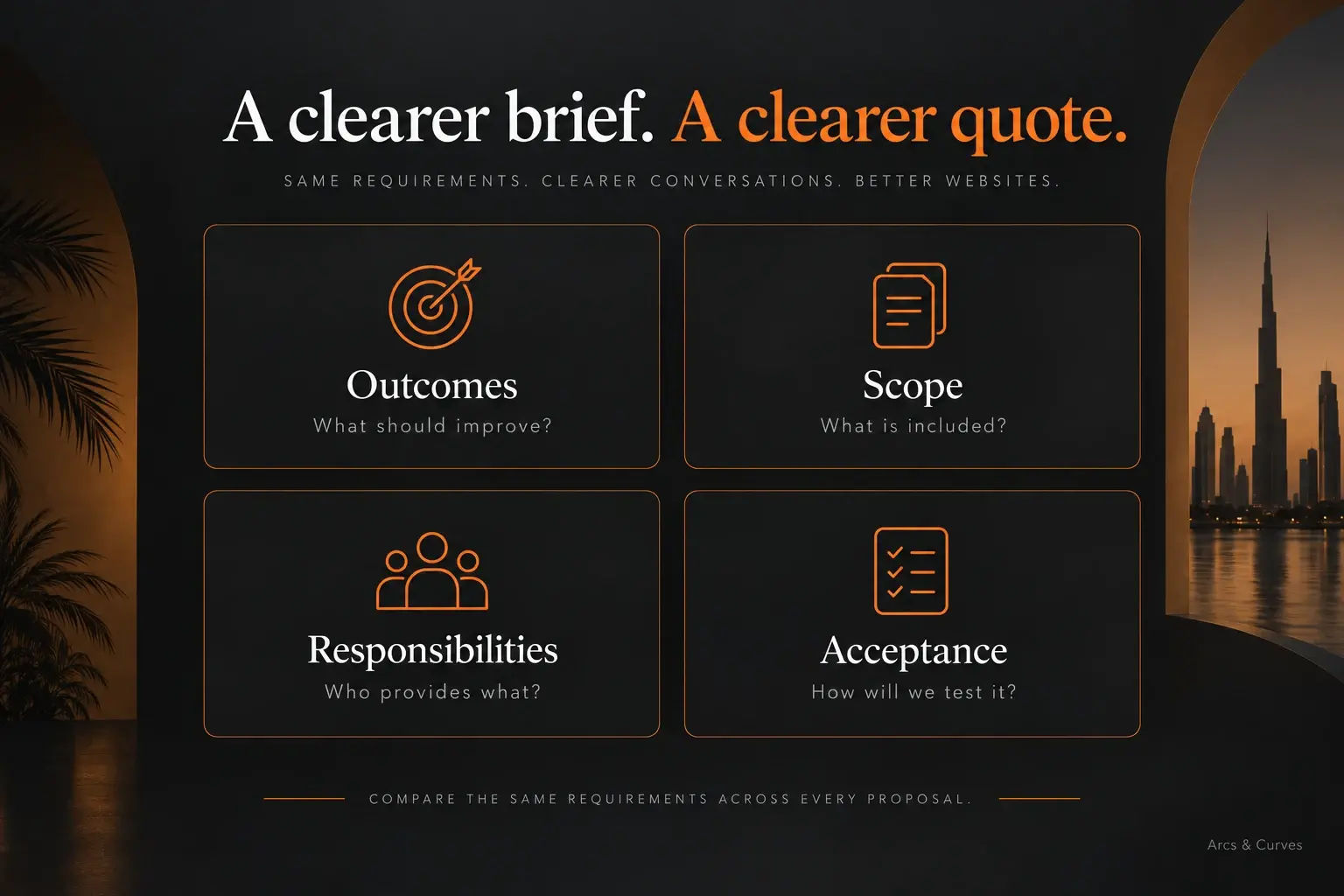
Check scope before comparing totals. Ask each agency to show what is included, optional or excluded against your brief. Then compare its explanation of the delivery process, responsibilities and acceptance tests.
A proposal that clearly identifies an unresolved integration dependency gives you a decision to make. A proposal that merely says “all integrations included” leaves the same uncertainty hidden. Seek a clear answer before treating the price as fixed.
Frequently asked questions
01. How detailed should a website design brief be?
Detailed enough for an agency to understand the outcome, audience, scope and dependencies. You can start with the table above and supporting documents. Complex functions may need a discovery stage before a reliable fixed scope can be agreed.
02. Should we choose the CMS before requesting quotes?
State any genuine constraints, such as existing systems or internal editing skills. If the choice is open, ask the agency to explain its recommendation against your requirements, ownership needs and ongoing costs.
03. Does every UAE website need Arabic at launch?
The decision depends on your audience, business requirements and applicable obligations. Record the intended languages explicitly. If Arabic is included, scope translation, right-to-left layouts and language review rather than assuming they are automatic.
04. Can an agency write the brief with us?
Yes. Ask for a defined discovery deliverable covering objectives, audience tasks, content structure, functions and open decisions. Confirm whether that work is a separate paid phase and what you receive at its end.
05. Turn the brief into a useful first conversation
Bring your current website, main business objective, available content and list of connected systems to the discussion. Those inputs help establish the decisions needed before design begins.