.webp?width=145&height=145&name=Hubspot%20Platinum%20(1).webp)


Selling IT consulting means helping a client make a decision that can affect their systems, people and business for years. A promising conversation may pass through a technical workshop, a security review and several commercial discussions before anyone signs. When I assess HubSpot CRM for IT consulting companies in Dubai, the UAE and the wider GCC, I start with a practical question: will it help the team manage those decisions with less confusion?
My view is that HubSpot is worth considering when marketing, sales and account management need a shared picture of the customer. Its value depends on how well that picture supports real work: understanding the buying group, progressing technical evaluations, handing over commitments and preparing for renewals. Buying more software alone will not solve those problems.
Is HubSpot the best CRM for IT consulting companies?
HubSpot can be the best CRM fit for IT consulting companies that need connected marketing, consultative sales and recurring account management. No CRM is best for every firm; delivery requirements, integrations and total cost must also guide the choice. It becomes easier to justify when the team uses it consistently across lead generation, opportunity management and account growth. It is less compelling when the main requirement is detailed resource scheduling, timesheets or project profitability; those needs deserve a separate delivery-system assessment.
I would evaluate it against five outcomes:
- Every qualified opportunity has a clear owner, next action and decision date.
- Technical and commercial stakeholders are visible to the whole account team.
- Marketing follows up with information relevant to the buyer’s problem.
- Delivery receives an accurate record of what was agreed.
- Renewals and expansion are planned before the contract is nearly over.
This is also how I would scope a conversation about HubSpot Sales Hub for UAE businesses: start with the decisions your team needs to make, then choose the tools.
Why IT consulting sales need more than a contact database
A technology services opportunity can involve a business sponsor, IT lead, security reviewer, procurement manager and finance approver. They may agree that change is necessary while disagreeing about timing, risk or scope. A single contact record and a hopeful close date leave too much unexplained.
The research supports being more thoughtful about how sellers participate. Gartner’s June 2025 report found that 61% of 632 surveyed B2B buyers preferred an overall rep-free buying experience. The survey ran in August–September 2024. However, buyers preferred seller input for tasks requiring contextual understanding, such as assessing fit. This is B2B research, not a UAE IT consulting benchmark. Source: Gartner’s buyer survey.
For an IT consultancy, I take that as a reason to make basic information easy to find and use human conversations for the difficult questions: migration risk, integration dependencies, internal readiness and commercial trade-offs. A CRM should help the consultant arrive prepared.
The same survey found 69% reported inconsistencies between a supplier’s website and its sales representatives. That finding strengthens the case for keeping published service descriptions, proposal assumptions and sales conversations aligned. It does not prove that installing HubSpot increases revenue. Source: Gartner, June 2025.
How I would structure HubSpot CRM for an IT consultancy
I would begin with companies, contacts and deals, using a small number of clearly defined fields. The structure should explain the opportunity without forcing consultants to maintain dozens of low-value properties.
| Record | Information I would capture | Why it matters |
|---|---|---|
| Company | Industry, country, account owner, existing services | Gives the account team commercial context |
| Contact | Role in the decision, area of responsibility, agreed communication preferences | Helps the team involve the right people |
| Deal | Business problem, service line, expected value, decision process, next action and date | Makes progress and gaps visible |
| Technical evaluation | Presales owner, dependencies, success criteria, outstanding risks | Keeps a demonstration or proof of concept tied to a decision |
| Customer relationship | Delivery owner, contract dates, review date, renewal owner | Connects the sale to the next commercial conversation |
These are proposed fields and working practices, not a claim that every item arrives preconfigured. Start with standard records and properties; validate any need for extra objects, custom associations or automation against the subscription you are considering.
For UAE and GCC operations, also decide how country, currency and ownership should work across offices. Keep a consistent definition of deal value. A one-off implementation fee, annual support contract and multi-year total contract value should not be mixed in the same revenue measure without explanation.
If you already have years of data in another system, our HubSpot CRM migration checklist sets out how to map and test it before relying on the reports.
A HubSpot sales pipeline for IT consulting companies
I prefer stages that describe evidence of buyer progress. “Demo sent” tells me what a seller did; “technical fit confirmed” tells me something more useful about the opportunity.
The following framework is an original planning example. Adapt it to your sales motion rather than copying it unchanged.
| Stage | Evidence needed to move forward |
|---|---|
| Qualified discovery | A business problem, credible sponsor and agreed discovery meeting |
| Requirements confirmed | Documented scope, decision process, stakeholders and target timing |
| Technical validation | Agreed evaluation criteria, named presales owner and key dependencies reviewed |
| Commercial proposal | A proposal built around the agreed scope, with a review meeting booked |
| Procurement and approval | Outstanding commercial, legal and purchasing steps identified with owners |
| Closed won or closed lost | A signed commitment or documented loss reason; won deals trigger a controlled handover |
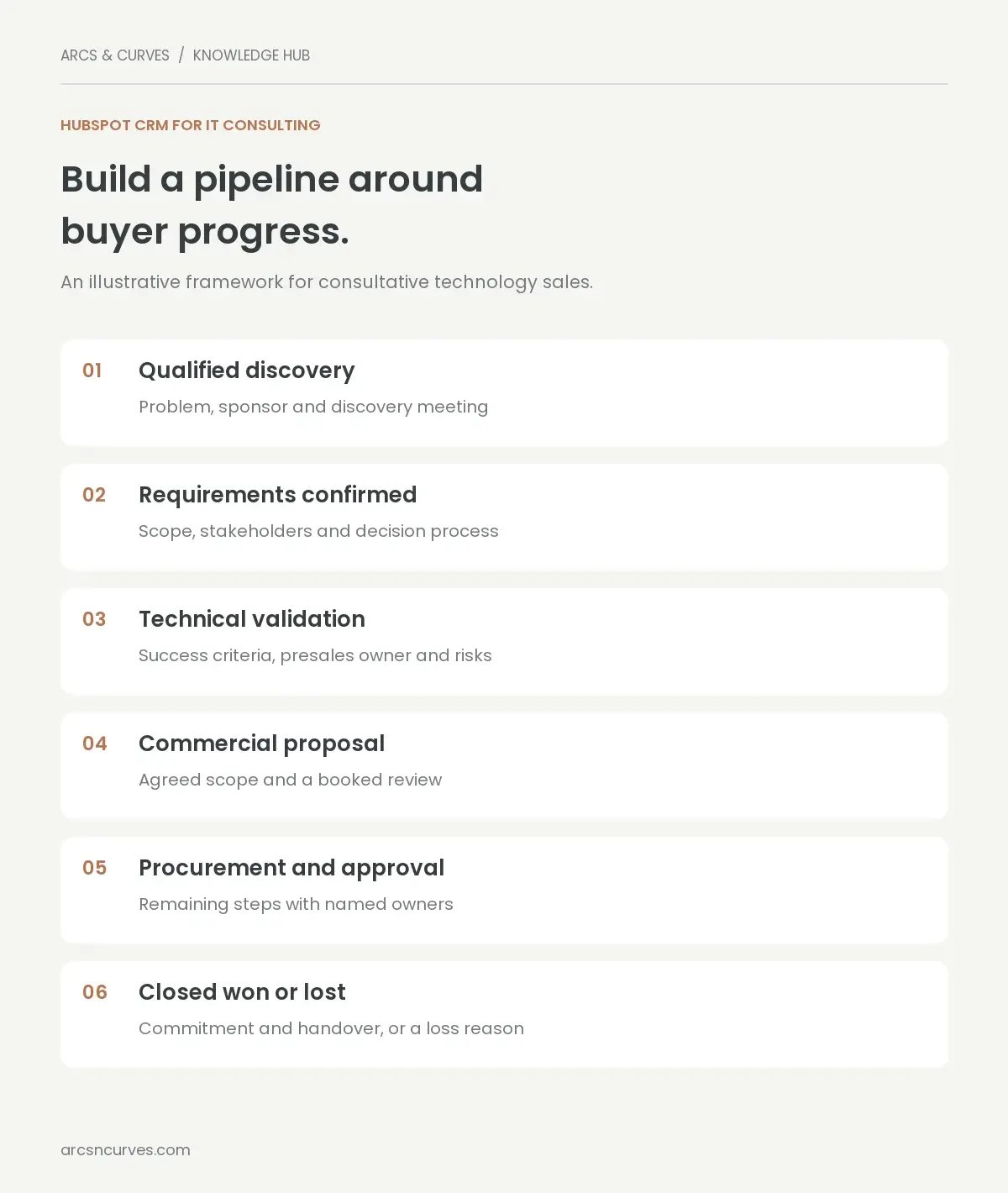
HubSpot supports configuring pipelines and stages, with limits and some controls depending on the plan. Its official pipeline documentation also recommends separate pipelines when processes genuinely require different stages. I would therefore avoid creating a pipeline for every service or country if the buying process is substantially the same.
At a weekly review, I would ask three questions for each material opportunity: what changed, what is blocking the decision, and who owns the next action? Record a reason when a close date moves. Over time, that makes the forecast more explainable, even when a deal still slips.
HubSpot automation for long IT consulting sales cycles
Automation is most useful when it prevents an agreed action from disappearing. I would start with a few narrow workflows and test exceptions before adding more.
- New qualified enquiry: notify the responsible owner and create a follow-up task.
- Technical evaluation opened: assign a presales task with an agreed completion date.
- Next action overdue: alert the deal owner, then escalate according to a documented rule.
- Closed won: request the handover information and notify the delivery owner.
- Renewal approaching: create an account-review task far enough ahead of the contractual notice deadline.
These are implementation patterns, not promises that all are available in every edition. HubSpot’s workflow object documentation lists subscription-dependent access. Confirm the trigger, action and object you need in the actual package before signing off the design.
I would keep marketing nurture separate from a salesperson’s personal follow-up. Someone researching cloud migration may benefit from a readiness guide, while a procurement contact may need a clear scope and responsibility matrix. Use recorded preferences and the appropriate communication permissions. Stop or change automation when a person replies or an opportunity’s circumstances change.
Connecting HubSpot sales to IT project delivery
A successful sale creates obligations. If those obligations remain in an email chain, the delivery team starts by reconstructing the promise.
My minimum handover checklist would include:
- The signed scope, commercial terms and agreed exclusions.
- The customer’s success criteria and acceptance process.
- Technical assumptions, integrations and access dependencies.
- Stakeholders, escalation contacts and internal owners.
- Expected start date and the delivery team’s capacity confirmation.
- Risks or unresolved questions acknowledged before kickoff.
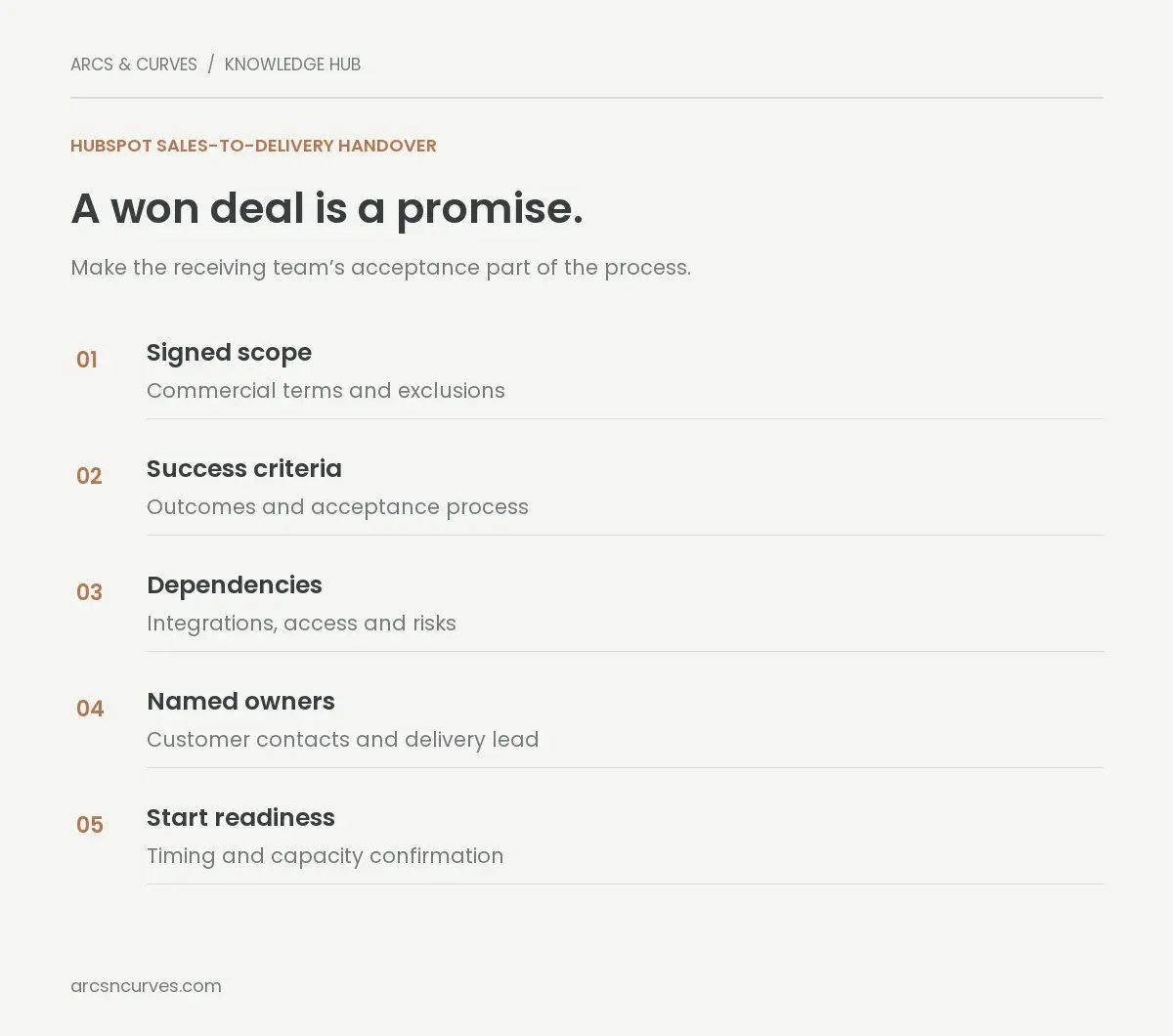
I would make a named delivery owner accept the handover. An automated notification is useful, but it is not evidence that the receiving team understands the commitment.
HubSpot can hold the commercial context and connect with delivery tools where a suitable integration exists. I would assess specialist requirements such as consultant utilisation, timesheets, resource planning, service management and project margin separately. Do not assume a CRM project record replaces a professional services automation platform. Test the integration on an actual workflow, including failed updates, duplicate records and ownership of each field.
This design work belongs in HubSpot onboarding and implementation, before the team starts building isolated automations.
Managing IT consulting renewals and account growth in HubSpot
For managed services and support agreements, the renewal process should begin with contract facts and customer outcomes. I would store the renewal date, any notice deadline, account owner and next review date, then use a process suited to the agreement.
An illustrative review cadence might begin 120 days before renewal, followed by a value review at 90 days and a commercial discussion at 60 days. Those intervals are examples, not a universal standard. A contract with a longer cancellation window needs an earlier process.
The account review should answer:
- Has the customer achieved the outcomes originally agreed?
- Are there unresolved delivery or support issues?
- Have stakeholders, priorities or budgets changed?
- Is the next opportunity a renewal, an expansion or a separate project?
Keep those opportunity types distinguishable in reports. A new project should not conceal a lost recurring contract. I would also avoid treating email engagement as proof of satisfaction; use a conversation and reliable service evidence.
What does HubSpot cost an IT consulting company?
HubSpot’s public catalogue, checked on 8 October 2026, lists Sales Hub Professional from US$100 per seat per month, with US$1,500 required one-time onboarding. This is a starting catalogue price, not a quotation for your business. Contract terms, discounts, tax, additional products and services can change the total. Source: HubSpot Product & Services Catalog.
For illustration, five Sales Hub Professional seats at that starting rate would be US$6,000 over 12 months; adding the listed onboarding gives US$7,500. This calculation excludes tax, implementation consulting, integrations, marketing products, training and any other charges. It is a budgeting example, not an ROI claim.
I would compare the full operating cost:
- Seats and product tiers needed by each role.
- Marketing contact volumes and any additional usage charges.
- Data migration, integration build and ongoing maintenance.
- Process design, training and internal administration time.
- Reporting, quoting or service features that require a different package.
A sensible business case measures what is happening today: time spent preparing pipeline reports, missed follow-ups, incomplete handovers and renewal surprises. Set a baseline before implementation, then review whether those measures improve. Do not count hypothetical recovered deals as guaranteed savings.
When HubSpot is the right CRM for UAE IT companies
I would shortlist HubSpot when your firm needs a connected commercial process and has someone accountable for maintaining it. That is particularly relevant when Dubai-based sales, regional consultants and account managers need to work from the same customer context.
I would slow down the purchase if the immediate problem is unclear ownership, inconsistent sales discipline or poorly defined services. Those issues need management decisions alongside the implementation. A simpler setup may be sufficient for a small team with a straightforward sales process; a heavily specialised delivery business may need a broader systems architecture.
Our HubSpot consulting services in Dubai can help translate those requirements into a practical scope. The useful outcome is a system your team can run and improve, with clear responsibility for data and adoption.
FAQs: HubSpot CRM for IT consulting companies
Is HubSpot suitable for small IT consulting firms?
Yes, it can be, but the package should follow the requirements. Start with the records, pipeline and follow-up discipline you need. Validate the cost of required automation and reporting before assuming an entry-level plan will cover the entire process.
Can HubSpot manage technical presales and proof-of-concept work?
It can record the opportunity, owners, dates and commercial context around a technical evaluation. Use agreed success criteria and links to supporting documentation. Detailed engineering work may remain in a specialist tool, with relevant status shared back to the CRM.
Does an IT consultancy need every HubSpot product?
No. Identify the sales, marketing, service and quoting requirements separately. Check which features and seat types are included in the proposed subscription. Buying every product before validating the workflow increases cost without demonstrating value.
Can HubSpot replace our project management or ERP system?
Do not assume it will. Evaluate delivery scheduling, utilisation, finance, billing and other operational requirements individually. The better architecture may connect HubSpot’s customer and opportunity records with the systems already responsible for those activities.
What should I test before committing to HubSpot?
Run a realistic opportunity from enquiry to handover and renewal planning. Include multiple stakeholders, a delayed evaluation, a changed scope and an integration failure. Ask the people who will use the system to complete the tasks and identify the gaps.
My recommendation for IT consulting leaders
I would judge HubSpot by whether your team can answer three questions confidently: what is the customer trying to achieve, what must happen next, and who owns it? If the implementation makes those answers clearer from first enquiry through renewal, the investment has a credible purpose.
Before selecting a package, map one representative deal and one existing customer relationship. Then discuss a HubSpot CRM implementation around those real processes. That gives you a much stronger basis for a decision than a feature checklist alone.
About the author: Asif Ahmed is the Founder & CEO of Arcs & Curves and a HubSpot Consultant.